

Most guitar players learn chords as static shapes: grab a chord, strum it, then jump to the next one.
Triads change that. Once you understand where triads live on the fretboard, the next step is learning how to move between them musically. This is where triads stop being a theory concept and start becoming a practical tool.
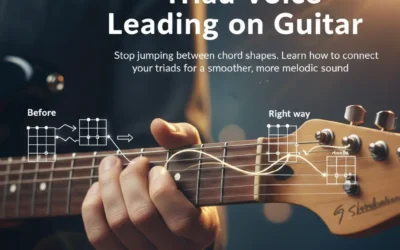
This lesson focuses on using triads in chord progressions — specifically through voice leading. No advanced theory required. Just small, intentional movements that sound better immediately.
What Is Voice Leading? (In Guitar Terms)
Voice leading simply means: moving each note the shortest distance possible when changing chords.
Instead of jumping from one full chord shape to another, you let individual notes move by:
- A half step
- A whole step
- Or stay the same
Triads make this easy because they only have three notes.
Why Triads Are Perfect for Voice Leading
Triads:
- Appear everywhere on the neck
- Share notes across many chords
- Have multiple inversions close together
That means when a chord changes, you often don’t need to move far at all. Most of the time, one or two notes shift slightly while another stays put — that’s the sound of smooth harmony.
Example: I–V Progression (C → G)
Let’s keep this simple:
C major triad: C – E – G
G major triad: G – B – D
Notice something important:
👉 Both chords contain G.
That shared note gives you an anchor. Instead of jumping to a new position, you can:
- Keep G where it is
- Move C → B
- Move E → D
Each note moves the shortest distance possible. This is voice leading in action.
Staying in Position Instead of Jumping Shapes
A common mistake is thinking:
“New chord = new shape somewhere else on the neck”
Triads allow you to:
- Stay in one position
- Choose the closest inversion
- Let the progression unfold horizontally
This is why professional players sound connected even when playing simple progressions. They’re not thinking shapes. They’re thinking movement.
Common Progressions to Practice with Triads
Start with progressions you already know. Try these:
- I–V–vi–IV: Used everywhere. Practice staying in one area of the neck and finding the nearest triad for each chord.
- ii–V–I: Great for hearing smooth resolution. Listen for half-step motion.
- I–vi–IV–V: Pay attention to which notes remain the same between chords.
The goal is not speed. The goal is awareness.
Listening Exercise (Important)
When practicing triads in progressions:
- Play slowly
- Let each chord ring
- Listen to how individual notes move
Ask yourself:
- Which notes stayed the same?
- Which moved by a step?
- Which inversion sounded the smoothest?
This is how your ear starts to guide your hands.
Why This Changes Everything
Once you internalize voice leading with triads:
- Chord changes feel effortless
- You stop guessing where to go next
- The fretboard feels connected
- Rhythm and lead playing begin to overlap
This is the bridge between knowing shapes and making music.
How This Connects to the Bigger Picture
Voice leading explains:
- Why inversions exist
- Why certain chord movements sound strong
- How melodies emerge from harmony
And under all of it is one idea: Music moves by small steps — not big jumps. Triads make that visible.
What’s Next
In the next lesson, we’ll zoom in on intervals — the distances between notes — and show how they explain why triads and voice leading work the way they do.
If you practice slowly and intentionally with this lesson, everything that comes next will feel easier.
🎸 Happy practicing!

0 Comments